
I am a huge admirer of authors who can come up with clever, original, twisty plots. As a writer myself, this is, I feel, not one of my strengths, so I am in awe of those for whom it clearly is. Chloe Benjamin, in this novel at least, is definitely one of those authors. The following review contains one or two spoilers.
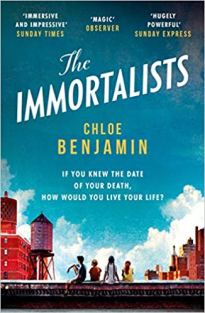 The novel begins in 1969 with the four children of the Gold family – Varya, Daniel, Klara and Simon – visiting a fortune-teller in her grimy downtown New York apartment, who is said to be able to predict the date of a person’s death. The mystic consults each child privately about their fate. Their reactions vary; Daniel, the second oldest, for example, says he thinks it is all rubbish. The younger children seem more vulnerable and more preoccupied, particularly Simon, who at this point is only seven years old, and who is told that he will die young.
The novel jumps forward ten years when the children’s father, Saul, dies. This leaves their needy mother, Gertie, distraught. It was expected that Simon would continue the family tailoring business, but this is very far from his intention. With the fortune teller’s prediction preying on his mind, he is easily persuaded by Klara to leave New York and make a new life for himself in San Francisco, where, free of family expectations, he can lead a more fulfilling life. Simon is gay, something Klara recognises clearly, but they both know that this truth would be devastating to their traditional Jewish mother. Simon could never follow in his father’s footsteps.
Simon not only moves to the other side of the country, but he breaks away from the family completely, much to the consternation of Daniel, who sees Simon’s behaviour as wilful and selfish. It also means that someone else will have to care for their mother, a role that Daniel expected Simon would take on. We watch with trepidation the hedonistic lifestyle that Simon leads. It is the early ‘80s and there is talk of a terrible new ‘gay disease’. Simon’s behaviour has a kind of death-wish about it.
Spoiler alert!
Simon dies – but that might not really be a spoiler, because you know it had to happen! Once Simon’s death becomes inevitable, the narrative of the book becomes clear. The author teases us by inviting us to consider whether Simon’s death was an accurate prediction by the fortune-teller, or whether being given a date of death drives us towards fulfilling that prediction. To what extent is our destiny within our control, and to what extent mapped out for us? Did Simon in fact escape one kind of destiny (the one his mother determined, life as a tailor in the family business) for another (dying from a horrible incurable disease)?
Next, we are told Klara’s story. Klara is the most bohemian and perhaps the most fragile of the four Gold children. She meets and falls in love with Raj. They have a daughter and after some lean years on the road, they eventually develop a highly successful magic act with a residency in Las Vegas. They call themselves The Immortalists, after their seemingly death-defying tricks. Success is a burden for Klara, however, and this, coupled with her unresolved grief over Simon’s death, leads her into a life of alcoholism. Klara is fascinated by the life story of her grandmother, also a travelling magician, and replicating some of her tricks becomes part of the magic act. Whilst trying to emulate a particularly dangerous one, she hangs herself in a hotel room – deliberately? Was she trying to cheat the prediction?
Daniel was the most sceptical of the children. He is convinced that Klara and Simon’s deaths were caused by the fortune teller’s predictions and, with the aid of a police officer who once met Klara, he hunts down the elderly fortune-teller hoping to bring her to justice. The hunt becomes an obsession for him. I won’t reveal the rest of Daniel’s story.
Finally, there is Varya, who was told by the fortune teller she would live to 88. She is working as a senior biologist conducting experiments into longevity using monkeys. Varya, like all her siblings, has some considerable mental health difficulties. She has severe anxiety and OCD, restricting her calorific intake to prolong her life (as she does with her monkey research subjects) and shunning meaningful human relationships – has Varya become dangerously obsessed with fulfilling the fortune-teller’s prediction? Her world is turned upside down when her favourite monkey becomes gravely ill in the experiment and Varya breaks with protocol in a way that threatens the costly research project, an act which damages her professionally. She also she meets a young journalist, who claims to be interested in her work but who is not in fact who he says he is. Varya’s ordered, controlled life unravels and she must face her demons, not just for her own sake, but on behalf of her troubled siblings too.
The story has a brilliant ending with Ruby (Klara’s daughter), and Gertie, the Gold children’s mother, coming together at the end. I listened to this on audiobook and was totally hooked. It’s a long but extremely satisfying book, so many threads, brilliantly woven together. Some reviewers have said it has too many clichés, others found aspects of the plot contrived, but I absolutely loved it.
Highly recommended.
If you have read The Immortalists I would be interested to know what you thought of it.
If you have enjoyed this post, I would love for you to follow my blog. Let’s also connect on social media.

 The book incorporates cognitive behavioural therapy techniques into exercises for addressing, for example tendencies to be self-critical. Low self-esteem can lead to debilitating inhibition, irrational fears, in both social and professional situations, and, I believe, can truly limit one’s life experience, achievement, enjoyment in life and personal relationships. I have found it really tough working through this book, particularly the chapters which focus on understanding the causes of poor self-esteem. Thinking about my relationship with my parents, in the aftermath of my mother’s death just a few months ago has not been easy.
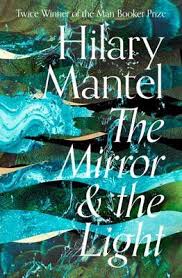 I think we can believe the hype – this is surely a writer at the top of her game! A few lucky critics who have had a preview have already tipped it for this year’s Booker Prize (parts one and two both won in 2009 and 2012). I am a huge fan of Mantel, ever since I read “A Place of Greater Safety”, a novel about the aftermath of the French Revolution. It was the book that really got me back into reading after I’d finished my English degree – I was all ‘read-out’ by the time I graduated, so this book saved me!
 There are many other books to get excited about this year. Isabel Allende’s latest book A Long Petal of the Sea was published in English last month. It is a story about escapees from the Spanish Civil War arriving in Chile in 1939, their evacuation having been organised by the great national poet Pablo Neruda. I was lucky enough to attend a talk Isabel Allende gave in Manchester (with Jeanette Winterson!) a couple of weeks ago and she was every bit as impressive and inspiring as I expected her to be. AND I got a signed copy of the book!
 By the strangest of coincidences, I have also just read two books which also explore issues of race and class. Rebecca Skloot’s non-fiction work The Immortal Life of Henrietta Lacks, and The Water Dancer by Ta-Nehisi Coates. Skloot’s book is a detailed and complex account of one woman, Henrietta Lacks, an African-American woman from Virginia who died in 1951 from aggressive cervical cancer. The cancer cells from her body were special and unique because they were the first ever cells that were able to not only survive outside their host, but were able to continue to thrive and reproduce, at a rapid rate. This perhaps accounts for the very aggressive nature of Henrietta’s disease. Scientists used these cells, known universally as HeLa cells, to create trillions and trillions more of them, which have been used ever since, worldwide and have been directly responsible for the development of life-saving drugs and treatments, for example for polio. The key to the story, however, is that Henrietta died without ever having been advised about or consenting to the use of her cells in this way, neither did her family, and none of her surviving relatives have been given any financial compensation. What makes the story all the more shocking, however, is that Henrietta died at a time of segregation, and almost certainly did not receive the same level of care and respect as a white woman would have done. I will write more about this book in a future post because it is a fascinating story.
 The other book I have been reading, The Water Dancer, concerns the story of Hiram, a black slave also in Virginia in the mid-1800s. His mother was also a slave, but his father was a slave-owner, who allowed his son some elementary education after his mother’s death and then, when he was in his teens, gave him the special status of being the personal servant to his white half-brother, Maynard, the heir to their father’s estate. Hiram is also the grandchild of legendary slave Santi-Bess, one of the original transported Africans who is said to have had magical powers (Conduction), although it does not become entirely clear what these are until towards the end of the book. The first significant glimpse of this is when, whilst chaperoning Maynard on a drunken night out, the two young men somehow end up in the river. Maynard drowns but Hiram somehow emerges alive. The events which follow Maynard’s death eventually afford Hiram the opportunity to escape slavery via the Underground and he soon becomes an agent of that cause. It is not a straightforward choice for him, though, as he is forced to confront traumatic memories of his mother, who died when he was very young, and to face the many complex facets of slavery, its consequences, its victims and what it means to be free.

 A book I listened to at the end of last year was Ashes of London by Andrew Taylor. I borrowed it from the library when it was first published in 2017 but did not manage to get through it before I had to return it for someone else. It is a historical thriller set at the time of the Great Fire of London in September 1666 and is the first in Taylor’s Marwood & Lovett detective series. I have not yet read (or listened to) the second and third books in the series, both of which were published last year, but they sound intriguing.
 Last week I launched my

 It is truly a groundbreaking novel, but curiously, in my view, less in its own right than as an extension, a continuation of, the work started with the publication of The Handmaid’s Tale in 1985. What is also partly so extraordinary about The Testaments is how relevant its story remains over thirty years on from The Handmaid’s Tale. In spite of equality legislation, human rights legislation, more women in positions of power and authority, we still have world leaders able to express their misogyny openly and with impunity, and violence against women and girls seems as rife as ever. Atwood is Canadian, but her novel is a dystopian vision set in the United States, where, in the last year, we have seen the erosion of women’s reproductive and therefore health rights in some states and the substantial threat of more to come. This novel seems so urgent and necessary.


 Julia's books