It’s a week since Paul Beatty’s The Sellout was announced as the winner of this year’s Man Booker Prize, and, finally, I have finished it. There at least two other books on the shortlist that I have enjoyed more (I reviewed them here recently, Hot Milk and Eileen), but by golly this is an extraordinarily clever book! I’m not even sure I’m clever enough to review it! The blurb doesn’t really tell you what it’s about and the arty commentators I heard talking about it on the news when it won the prize, didn’t really say what it was about either (I’ll bet most of them had not even read it!) And I’m not surprised, because it is a really difficult book to describe. But, for what it’s worth, here goes…
 This is a novel about race in modern America where the white population seems to feel it has solved the problem of racism. Firstly, it abolished slavery and then set in place several pieces of legislation to reinforce racial equality. Unfortunately, this has not addressed a fundamental problem of disparity of outcomes between whites and blacks (or people of colour more widely), in academic achievement, income, social status, crime, you name it, the statistics paint a troublesome picture. The thesis of the novel is that, whilst white America is slightly uncomfortable with the facts as they stand, they can point to a number of black high achievers (not least the first African-American President) as evidence that they have done all they could. The under-achievement of the rest can be put down to, for example, their own fecklessness or problems of character.
The novel is set in Dickens, California, a predominantly black suburb of Los Angeles that is undesignated as a city and, literally, disappears from maps. Our central character, the eponymous Sellout, but otherwise nameless, known to us only as ‘Me’, seeks to restore its place through some unconventional methods, whilst also seeking to address problems associated with racial inequality. He decides to reintroduce segregation. He also takes a ‘slave’, Hominy an elderly bit-part actor who made a very small name as a black ragamuffin in minor films, made in an era when the black and white minstrels were quaint and funny. ‘Me’ takes his authority to do this from the fact that his father, an intellectual and social scientist, was a local hero of sorts. Known as the ‘nigger-whisperer’ he had a reputation for being able to calm down violent or suicidal black people, using his own brand of counselling and persuasion. He also set up the Dum Dum Donut Intellectuals, which met in the local Dum Dum Donut’s store to engage in great philosophical debates. We learn a great deal about Me’s bizarre upbringing; he had no mother and his father used some unusual techniques, including violence and intimidation, to instil in his son his own theories about the ‘black condition’.
The novel starts with a prologue, where ‘Me’ is being tried in the Supreme Court for slavery. The rest of the novel tells us how a black man could possibly get to this point. The novel has been described as a ‘satire’ (although I’ve heard that the author does not like it described thus) and as darkly comic. Certainly, there are parts which are very funny, in a bleak sort of way, such as the circumstances surrounding the father’s death. I can see it is also satirical in the tradition of Jonathan Swift and Gulliver’s Travels, it is both poking fun at and calling out the self-interested and those who perpetuate injustice. It is a really tough book to pin down, but there is a moment towards the end where ‘Me’ is describing what he calls “Unmitigated Blackness” as “essays passing for fiction”. For me, that’s exactly what the book is, and it’s the author having the last laugh.
It’s hard to say I enjoyed this book; I admired it, most certainly. It’s brilliantly written and if you just love seeing how artists can put words together in unique and beautiful ways it is a treasure trove; I spotted a 218-word sentence which was absolutely breathtaking. It has quick wit, brilliantly acute observations of the absurdities of life, and is rich in irony (not normally seen as an American trait). For me, though, it was slightly too much essay and not quite enough story (fiction). Besides the satirical politics of the novel, which are, it has to be said, profound and thought-provoking, there is the story of a nameless black man in a modern-day, still racist world, in the shadow of a domineering father trying to work out his place in the world. This did not come through as much as I would have liked, until the end.
It’s a great read, but a complicated one. You need to be up for the challenge.


 Autumn is becoming the new ‘new year’ for many people, lighter, brighter and generally a nicer time of year than January, which I’ve always felt was a really bad time to make resolutions and embark on new activities! On that theme, a lot of people I know are using October to make fresh starts or implement changes. For so many of us, transformation starts on the inside; if we have problems or issues we want to tackle or changes we want to make in our lives, it often means overcoming personal barriers – fears, phobias, addictions and the like – or building confidence in moving forward and realising dreams.
 This was the first book on my ‘read the Man Booker shortlist challenge’, which I set myself a couple of weeks ago. I really enjoyed it, but it’s a book that I will probably have to mull over in my mind for a while before I can really pin down what it’s all about, because it is operating on so many levels. I think that makes it the mark of a very fine piece of literature and the writing is sublime.


 Most of the novel is set during the Second World War. There are two main characters: Marie-Laure Le Blanc is a young French girl, fifteen when the war ends, who is blind and lives with her father, in Paris. Her father is a security guard at the Museum of Natural History with a talent for locks. He adores his daughter and makes intricate models of their neighbourhood to help her find her way around the streets. He also conceals small gifts in the tiny buildings and Marie-Laure has to solve complex mechanical puzzles to find them. When war comes they seek refuge in St Malo with Marie-Laure’s eccentric great-uncle, Etienne, who has severe agoraphobia and has not left his house for decades. They escape Paris just before the occupation and Marie-Laure’s father is charged with concealing a precious stone, one of the treasures of the museum, in order that it does not fall into the hands of the Nazis.
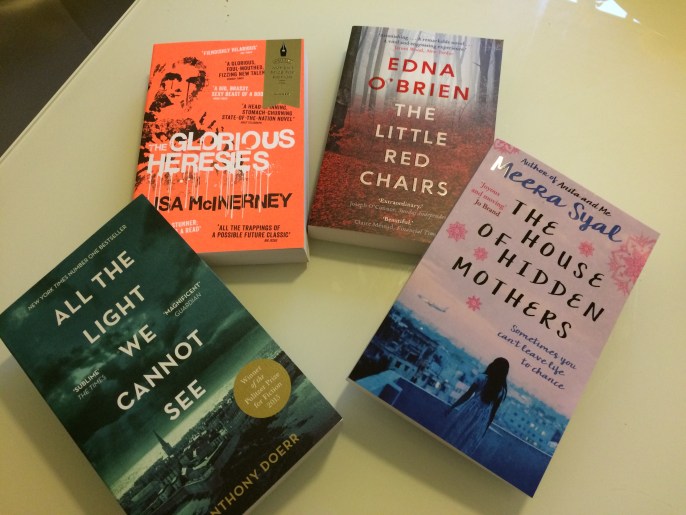
 So, my question is, should I have got an e-reader? With Christmas approaching (I’m sorry to remind you but we are entering retail’s ‘Golden Quarter’), it is possible I could ask Santa to bring me one. My practical self notes that the entry-level Kindle weighs just 160 grams and would fit into my handbag. Also, Kindle versions of e-books on Amazon seem to be much cheaper.
