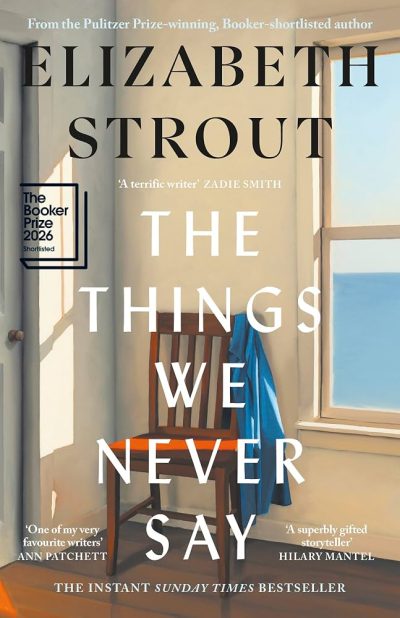
Booker shortlist review #2 – “The Things We Never Say” by Elizabeth Strout

This is Elizabeth Strout’s eleventh novel and takes her away from Maine and the cast of characters with which we have become so familiar, and to Massachussetts in 2024, around the time of the last US Presidential election. It is perhaps Strout’s most explicitly political novel to date. The novel has all the trademark elements of Strout’s writing which readers have come to love. The central character is Artie Dam, a middle-aged history teacher in a high school, beloved by staff and pupils alike, but he is a man disillusioned with life, who feels lonely and, when we first meet him, is contemplating suicide. Arty lives with his wife Evie, a psychiatrist, and their marriage is showing strains often seen in long relationships where people have become complacent. They have one son, Rob, a fragile young man who is in the process of getting divorced from his wife Francesca – she is a concert pianist and her life on the road has meant they have drifted apart. Rob has had a difficult time in relationships, one of his earlier girlfriends having been killed when the car they were in crashed, and which the girlfriend’s parents partly blame Rob for.

SPOILER ALERT

Artie’s world is rocked by two events which I will discuss here, so a bit of a spoiler, but I should add these happen in the early part of the novel – I am not going to reveal how it all resolves. First, Rob reveals to Artie that he is not his biological father – this is in fact a family friend (a man who is now dead and whom Artie was not fond of, though he remains close to the friend’s widow Flossie). In her desperation to become pregnant, and guessing that Artie might be the cause of their infertility, Evie obviously sought help from the family friend, who willingly obliged, and who then, rather spitefully, went on to inform Rob by letter before he died. Rob was about to confront his mother with the information, but when Artie walked in unexpectedly, missed his opportunity.

The second event is that Artie slips from his dinghy when trying to climb aboard his beloved yacht and almost drowns. He is saved by a local man, Ken. Ironically, the brush with death gives Artie a new reason to live and he begins a friendship with the man which will be one of the more enriching parts of his life.

The rest of the novel explores Artie’s relationships – his friendships at work and outside of work, particularly with Ken, and with his students. Artie is increasingly out of place at the high school, his ways seeming increasingly old-fashioned in the world he now finds himself in, but his students continue to respond to his basic human goodness, his care for them, and his commitment to his job. Most of all, however, there is Artie’s relationship with Evie and with Rob. Artie plans to tell Evie that he knows about Rob, but as time passes the couple seem increasingly distant from one another. Evie is absorbed in her own world and seems to have less and less time or patience with her husband. This conversation that they never seem to have, is it Artie’s avoidance, or as time goes by, his disinclination to try and reach her?

In contrast, Artie’s relationship with Rob gets closer; he finds that “the conversation” opens up a channel between them, they find they can communicate better once they have communicated about something ‘real’. Both men know that although they are not biologically related, their connection goes beyond that and is in fact far deeper.

Elizabeth Strout is such a good writer that you think she is telling you a simple story, but she is in fact exploring much more complex theses about what it is to be human, about the need for connection, and about the consequences for us all, as individuals and as members of society, when this breaks down. She even gives us some Jungian philosophy in this one and her characters discuss it without for one moment sounding false, pretentious or unnatural. Her characters come alive on the page, even the minor ones; she has that capacity to give you the whole via tiny details.

I loved this book and found it hard to put down. Highly recommended.
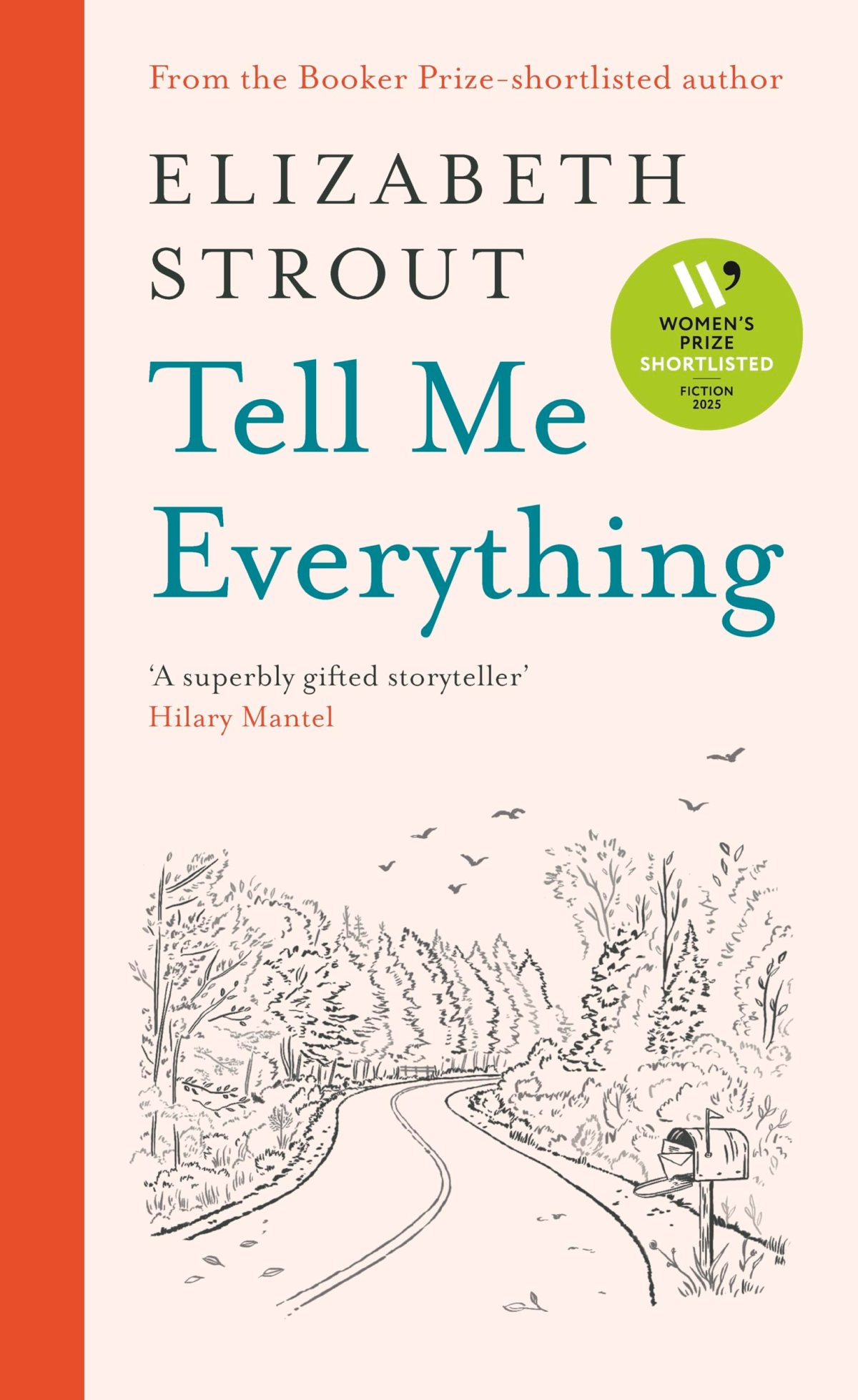
Women’s Prize shortlist book review – “Tell Me Everything” by Elizabeth Strout

Elizabeth Strout is the most experienced of the authors shortlisted for this year’s Women’s Prize and a writer I admire. I have not read all of her work, but I love her style and reviewed Oh William! on this blog after it was shortlisted for the 2022 Booker Prize. Strout writes many of her books in series, and Tell Me Everything  is book number five in her Amgash series (Oh William! was book number three). So, many of the same characters appear throughout the novels. She uses these characters in other novels too – for example, Olive Kitteridge appears in this book but she also has a book, in fact a two-book series, of her own! (Olive Kitteridge: A novel in stories and Olive, again). Some might not like this; it might seem that Strout is simply recycling, that she lacks ideas. I disagree. I think it takes huge authorial control and discipline to maintain  characters, remember their personality traits as well as their personal histories, but it also enables the author to take a very deep dive into the nature of what it is to be human and to observe over a long period of time the way that a person evolves and also the ways in which they do not change.

There is a bit of debate online about whether Tell Me Everything, or indeed any of the other books, can be read and enjoyed in isolation. As I said, I have not read her work extensively, but I certainly enjoyed Tell Me Everything and it really makes me want to go back and read her other novels. 

The central character in Tell Me Everything is Bob Burgess, a small-time lawyer and stalwart of the community in Crosby, Maine. This is quintessential Main Street America and, if nothing else, feels like an antidote to the more troubling vision of the United States that appears so often on our television screens these days. Bob spends most of his time on what we might call “pottering” until he is contacted out of the blue by a former school-mate who asks him to defend her brother, Matthew Beach, who stands accused of the murder of their mother Diana. Matthew is a lonely isolated man, probably neurodivergent, who lived with and cared for his sometimes cruel mother. 

As Bob begins to investigate he uncovers secrets about the family, the past, with which he is linked of course, living in a relatively small community and having gone to the same school as Matthew’s sister, and events beyond Crosby which seem to come back to impact on the town and its inhabitants. The case is not easy for Bob – he seems to be one of life’s innocents and he is shocked and hurt, not only by what he uncovers, but also by turns of events which affect the people around him. 

Bob shares many of his thoughts with his close friend Lucy Barton, central character in many of Elizabeth Strout’s novels, and through their discussions Strout is able to explore the central human questions and concerns that underlie both this case and other events going on around them. These other events include the serious illness of Bob’s brother’s wife, the professional challenges faced by Bob’s wife Margaret, the local minister, and Lucy’s relationship with her husband William, a man she once left due to his infidelity but who she now lives with again. There is also the Lucy Barton/Olive Kitteridge dimension; Olive lives in a retirement home but the two women strike up what appears to be an unlikely friendship, but after many get-togethers in which Olive shares lengthy stories about herself, her family and the many people she has known in Crosby, the two women find they have much in common – a deep interest in people. 

Though in many ways this seems like an old-fashioned novel with mostly middle-aged people in a small town with small lives, Strout brings in some very contemporary problems – child abuse, the opioid epidemic and other addiction problems, poverty, and family differences causing irreparable conflict and damage. All of these very modern problems impact on the characters and events in this novel.

I loved this book and could not put it down. My book club was divided – which probably reflects how readers more generally feel about Elizabeth Strout. I accept that her books might be a bit “Marmite”! I also love the way Strout writes – it appears simple, but is deceptively so, perhaps the hardest kind of writing to actually do. And her dialogue, which makes up a very high proportion of the book, is so natural. Her observation of people is brilliantly acute.

Of all the books on the shortlist this was the one I enjoyed the most, I think, but I can see it may not be the most consequential and therefore not one of those that was likely to win despite the author’s reputation and stature.

I recommend it highly though.