And finally, that’s the children sorted out with fiction and non-fiction recommendations. How about some ideas for the grown-ups? Walk into any bookshop at this time of year and you will be spoilt for choice; there are lots of celebrity biographies, cookbooks, beautifully illustrated books featuring plants and animals, compilations, self-help books and gorgeous coffee table books. Many of these can be quite expensive.
If you feel a bit overwhelmed, here are a few ideas.
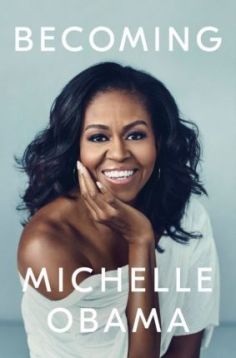 Becoming by Michelle Obama
You would have to have been living under a rock these last few weeks to have missed the publication of this! I wouldn’t normally recommend a celeb biography, but I can’t not. If it’s a bit big or a bit pricey, you could instead try the Pocket Michelle Wisdom which I spotted in Foyle’s in Birmingham last week.

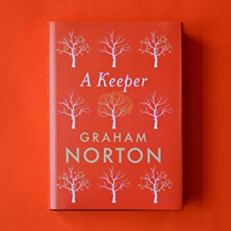
A Keeper by Graham Norton
I loved Graham’s first novel Holding and I’ve read some good reviews of this one too. I hope Santa brings it for me!

Normal People by Sally Rooney
Recently announced as the Waterstones book of the year. The story centres on the intense relationship between Marianne, who is young, clever and affluent but shy, and Connell, a likeable boy, but living in the shadows of his family’s poverty and reputation. An unlikely pairing that will have consequences for them both.

21 Lessons for the 21st Century by Yuval Noah Harari
More accessible philosophy from the bestselling author of Sapiens and Homo Deus. In this book Harari focuses on the present and invites us to consider issues such as nuclear weapons, fake news and parenting. With so much debate about the future of our species, this is a must for high-brow dinner party goers.

Notes on a Nervous Planet by Matt Haig
Listened to it, read it, loved it, reviewed it and will be giving it. Fab book about how to survive the challenges of modern life.

Codename Villanelle by Luke Jennings
For fans of the wonderful BBC series Killing Eve which was screened in the early autumn, here is the book on which the series is based.
 Ottolenghi Simple by Yotam Ottolenghi
I have followed Yotam Ottolenghi’s recipes in The Guardian for years but have rarely cooked them because they are usually far too complex or involve way too many ingredients. In this, his latest publication, Ottolenghi takes on that criticism and all the recipes in this book are said to be quick to make and contain fewer than ten ingredients, without sacrificing flavour. What’s not to love!

Vladimir Putin: Life Coach by Rob Sears
Browsed through this in the bookshop and thought it was hilarious. Great little stocking filler.

Educated: A Memoir by Tara Westover
This book has been a sensation this year and is a must-read. The author grew up in rural Idaho as part of a survivalist family and was not allowed to go to school until at the age of 17 she took matters into her own hands. She went on to study at Harvard and Cambridge Universities, but at what cost to her relationship with her family? Has won oodles of prizes.
So, I hope all that gives you food for thought. Would love to hear any recommendations you might have.
If you have enjoyed this post, I would love for you to follow my blog. Let’s also connect on social media.

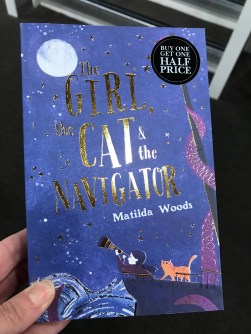 The Girl, the Cat and the Navigator – Matilda Woods
 Ladybird Tales of Adventurous Girls
  Dog Man Lord of the Fleas – Dav Pilkey
 Flamingo Boy – Michael Morpurgo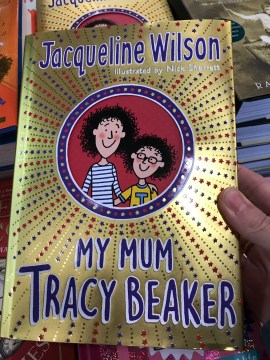


 Dumplin’ – Julie Murphy


 As I have been told many times by some of the people in my household, today is the official start of Christmas as it is the first Sunday of Advent (sounds like a bit of an excuse to me since we are not a religious family). Not quite feeling it myself yet, but then I tend to prefer to hold off for another week or two so as not to feel too exhausted by it all when the big day finally arrives. There is no doubt though, when you have children, or just a larger extended family with some children in it, you kind of have to get a little organised otherwise things can get a bit stressful.
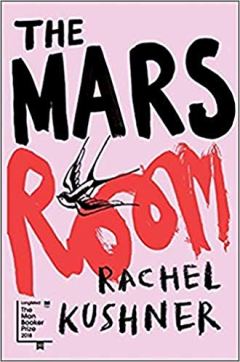 So much so that I had to have a break from all the heaviness to read something a little more uplifting and which didn’t tax my brain quite so much. I wasn’t very well last week and simply couldn’t face into The Mars Room (next on my Man Booker list) – if you have heard it is bleak, well it is! So far (not quite finished it yet). So, with my blanket, hot water bottle and cups of tea to hand I settled onto the sofa and read Rachel Joyce’s The Music Shop cover to cover in one day. I simply could not put it down.
 This book came to my attention last year. I really liked the sound of it and recommended it in one of my ‘what to look our for this season’ blogs, so it was on my TBR list. Then I saw Rachel speak at a Writers & Artists Conference I was at in September. She was such a wonderful speaker, really warm, authentic and engaging, that I had to get a copy of this book and have been eager to start it. It was a joy and just what I needed, when I was feeling unwell and when my brain was starting to hurt from the Man Booker. Look out for my review of The Music Shop next week.


 One thing that is so impressive about Chevalier is how beautifully she creates the historical setting: the two novels I have read so far have been set in 17th century Holland and 15th century Paris and Brussels and I can only begin to imagine the amount of research she has to undertake. The Last Runaway is set in the United States in the mid-nineteenth century when parts of the country were only just being settled. Honor Bright, our main character is a young Quaker woman from Dorset in England. She has led a modest and sheltered life, but her world was turned upside down when her fiancé left her and their close-knit Quaker community for another woman. This was not only a scandal but it left Honor distraught and in a very difficult position. When her sister, Grace, is persuaded by her fiancé that they should move to America, Honor decides she must go with her, not only to support her sister, but to escape the oppression of her situation and have some chance of making a life for herself.
 I am fortunate to live in an area where we have more than our fair share of trees, of woodland and common land where I can walk, enjoy the fresh air and observe the changing of the seasons, truly one of the nicest things about living in northern Europe. The leaves seem to have been falling around me for some time, but I think the extremely dry weather over the summer caused this. Now, the leaves are visibly beginning to turn from green to various shades of red, yellow and brown and the scenery around me is taking on new vivid hues. In a couple of weeks it will be stunning.
 The plot is not complicated: ‘Swede’ Levov is a third generation Jewish immigrant whose grandfather came to America from Europe. He was a glovemaker and set up a business in Newark, New Jersey which became highly successful. Swede’s father continued the business, which peaked in the 1950s and 1960s when glove-wearing for respectable women was the norm and most would have several pairs. (There is more information on gloves in this book than you will ever need to know, but it’s fascinating!) Swede inherited the business from his father, while his more wayward brother became a cardiac surgeon.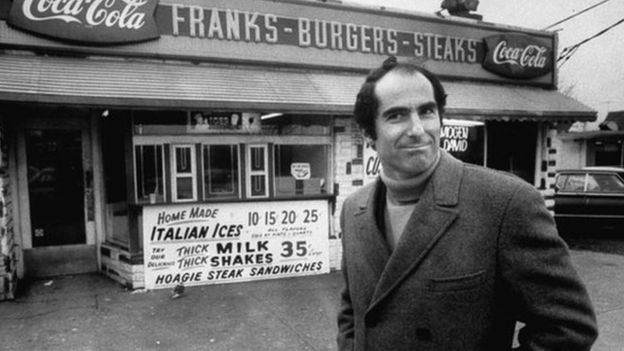
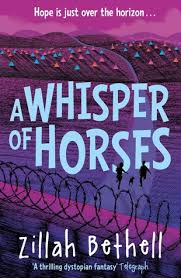 The novel is set in Lahn Dan, you’ll recognise the pun, but the place described in the book will be unfamiliar; it is practically a separate city-state within England, encircled by the ‘Emm Twenty-Five Wall’ that none of the inhabitants dare cross (told that there is only a deserted wilderness on the other side anyway). This is a time after ‘the Gases’ (a reference to climate change), the ‘Tems’ has deteriorated to a muddy flat and only the rich are able to live in the ‘crystal towers’ that afford them some natural light and allow them to live above the pollution layer. In a nod to Aldous Huxley’s Brave New World there is a strict hierarchy in the society: at the bottom are the Pbs, who do most of the work, then slightly higher up are the Cus, the professional classes, but true power lies only with the Aus. Give the child a prize who spots that these are chemical symbols and what this says about the social order! Lahn Dan is run by ‘the Minister’ a distant and slightly mythical figure, not unlike Big Brother, whose orders are carried out by Mordecai and his Secret Police. It all has echoes of 1984.
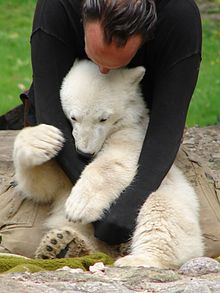
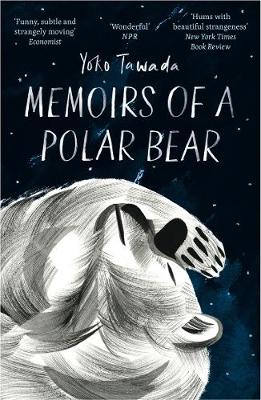 I’ll summarise the basic story of the novel. Part one is the most surreal and the most difficult. It is narrated by the nameless ‘grandmother polar bear’ (grandparent to Knut, star of part three). She has been reared as an attraction in the Soviet Union, by a cruel master, who, among other things, teaches her to stand on her back legs using what we would now regard as unethical methods. I think that by getting the bear to stand like a human the author justifies the morphing of her subject into something less animal. Throughout this part we are asked to suspend our disbelief: the bear escapes Soviet Russia, writes her memoirs, and flees to Germany, where she is ‘protected’ by an unscrupulous agent who simply wants to exploit her because her book has been so popular. The bear visits bookshops, makes human friends and animal enemies (the sea-lion publisher who makes ever more unreasonable demands). It’s all very tricky for us as adult readers.