
It’s been a very busy few weeks, so my reading rate has been somewhat below par. Besides half term (which, actually, was relatively low-key and relaxing) I’ve been having some further work done in the house; it was a like an ’80s museum when we bought it three years ago and we are gradually working our way through it, room by room. We have been having the final two bedrooms refurbished which has entailed complete chaos, clothes and stuff everywhere, and two weeks on a sofabed. I love it that our builder is happy to work with us in our ‘organic’ (procrastinating!) way, but we are our own worst enemy when it comes to getting the job finished! When we decorate we do so for the long-haul so it has to be right. Consequently, it was the end of October before I got around to reading an autobiography for last month’s reading challenge.
 I was really torn between Claire Tomalin, Anjelica Huston and Alan Cumming. I left it in the hands of the local library and it was Alan Cumming that became available first! I’m still waiting for Claire Tomalin, and that is probably the one I was keenest to read. I was attracted to Alan Cumming’s book, however, because its premise is not dissimilar to the book I am writing, namely family research and the uncovering of a long-held secret. There the similarity ends, however, as Alan’s book is much more about his relationship with his father.
I know very little about Alan Cumming, having seen nothing of his work that I can remember (although apparently he is in Stanley Kubrick’s Eyes Wide Shut with Tom Cruise and Nicole Kidman, a film I have seen a couple of times, though I don’t recall him in it). He now works mainly in the US and has done quite a bit of TV over there. He was born and grew up in rural Scotland, where his father managed a saw mill. Alan’s father was violent and abusive and the nature and frequency of the aggression Alan experienced is upsetting. What is clear from the outset, however, is that the young Alan can find no explanation for it.
In 2010, Alan was invited to appear on the BBC television programme Who Do You Think You Are? where the family history of a celebrity is explored and hopefully something interesting and unusual emerges. In Alan’s case, the mystery to be solved was that of his maternal grandfather, who died in mysterious circumstances as a result of a firearms ‘accident’ whilst serving in the Malaysian police force. It was during the filming of the show that Alan was told by his then terminally ill father, with whom he had had no contact for many years, that he his not in fact his son, but the product of an affair his mother had with another man. This sets Alan off on a journey of self-discovery, forcing him to face up to many of his demons.
It is an engaging and at times very moving story. I’m not sure if there was a ghost-writer involved, but it is well put-together and flows nicely. It’s a decent read, and you’ll like it if you’re a fan of Alan’s work, or if you can relate to any of the themes. What I most admired was how he managed, after such an inauspicious start, to break out of the constraints of his background and upbringing, to become a successful, globe-trotting actor, living in New York, at peace with himself. To that extent it is inspiring.
 For November, the challenge is to read a book set in or by a writer from the southern hemisphere – which is, broadly, South America, southern Africa and Australasia. As the nights draw in and it gets increasingly wintry I wanted to be reminded that in other parts of the world it is Summer! So, my choice this month is Isabel Allende’s Portrait in Sepia, a book I picked up in my local Oxfam bookshop and which has been sitting on my ‘to read’ pile for far too long. Allende is such a fine writer and I’ve read a number of her books over the years. It’s great to have an excuse to dive into this one and experience the sensuousness of her writing and the world she evokes, as the last leaves fall from the trees here and nature seems to go into hibernation.
What are you reading this month?
If you have enjoyed this post, I would love for you to subscribe to my blog by clicking on the ‘Follow’ button.
 I read A Clockwork Orange on my husband’s recommendation, straight after he’d completed it – it’s one of his favourite films, which we have watched many times, but neither of us had read the book. It’s quite short, but also quite hard-going as it is narrated by the central character, Alex, who speaks in ‘nadsat’ a kind of teenage vocabulary of the future, based loosely on Slav languages. I read it with a glossary (though Burgess intended that it should not be), but after while I found I did not consult it, and it flowed better just to read it and understand the sense, if not every word.
 The cover is lovely and there are a handful of illustrations in the book which are truly beautiful and very evocative. The apparent subject matter (animals) and the fact that it has some illustrations might put off some of the target readership (10-11 year olds, I would say), particularly the more advanced readers among them, who might think it is better suited to younger ones. The themes, however, are much more mature than you might think and may in fact be upsetting to more sensitive 9-10 year olds, say. It is perfect, therefore, for older primary school kids who are perhaps more reluctant readers who may find some of those thick volumes a bit daunting. At 276 pages, with a few pictures and nicely spaced typeface, this is a book where pages will be turned quite quickly; in my experience, this is a surprisingly important factor in many children’s enjoyment of a book!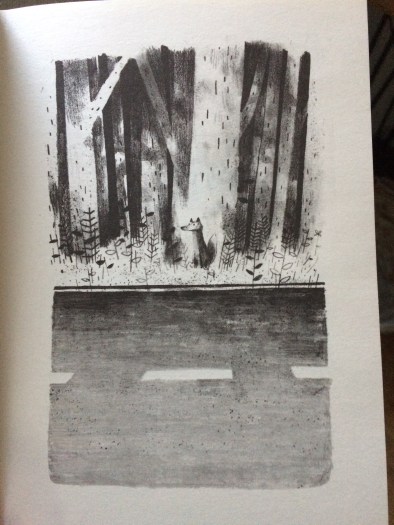
 It’s a tough one to review without giving too much away, and the comments on the jacket don’t say very much about the story either, only that it is “exquisite”, “compelling” and “forcefully moving”. The central character is Linda (also Madeline or Mattie to her parents), who is an only child living with her parents in small town Minnesota. To say they live in a rural environment is an under-statement; they live in a cabin in the woods, which they seem to have built themselves, with their dogs. It seems they were formerly part of a small commune, but the other residents have gradually moved away as the cooperative spirit broke down. Linda’s parents are rather remote and she is allowed to roam the area freely, to canoe on the lake as and when she pleases, and to walk many miles in all weathers.
 There are a couple of titles that have been on my reading list for a while. The first is Scottish actor and comedian Alan Cumming’s Not My Father’s Son, which was published in 2014. It is linked to his appearance in BBC TV show Who Do You Think You Are? in 2010 in which the result of his research caused him to reflect on his family, his upbringing and, in particular, his relationship with an abusive father. It has received glowing reviews and has also won prizes. The theme of secrets and family research is close to the book I am writing myself so it could be helpful. Or it may just make me feel like givng up now!!!
 Finally, I saw in the bookshop recently that Claire Tomalin has written A Life of My Own, where, for a change, she is writing about herself. I admire Claire Tomalin hugely; she has written some of the finest biographies produced in recent years, covering subjects such as Jane Austen, Samuel Pepys and Mary Wollstonecraft. She has led the most astonishing life: an unhappy childhood, four children, the death of her husband, the loss of a child, and the eternal struggle between motherhood and work. I think I would find this book truly inspiring.
 The narrator and central character is Daniel, who lives with his father (always “Daddy”) and his sister Cathy (a nod to Wuthering Heights, I wonder?) somewhat on the margins of society. Initially, they live with Granny Morley somewhere in the north east, and seem to attend school regularry, though not particularly successfully; it is clear they are ‘different’ and considered outsiders, rather akin to travellers. Cathy and Daniel’s mother has been mostly absent, seemingly a troubled soul with mental health problems and probably addiction, but who then disappears completely, assumed dead. Daddy is a more reliable carer, though he too is frequently absent as he tours the country competing in illegal boxing bouts. He is at the top of his game, however, unvanquished wherever he goes, and seems to make enough of a living from this activity, as well as making plenty of money for those with sufficient funds to gamble heavily on his success.
 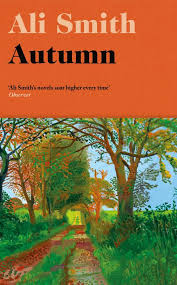 Ali Smith has said that she wrote this book very quickly in the aftermath of the EU referendum in the UK last year. As UK citizens will all understand by now, as we continue to reflect upon/reel over the events of Summer 2016, the outcome of that vote was about so much more than should Britain remain in or leave the European Union. That our social, cultural and political path in this country could be determined by a simple yes or no answer to that question now looks absurd. The election of Donald Trump to the US Presidency in November last year was another cataclysmic event, which provides the context to this novel. Ali Smith has, I believe, outside this book, nailed her political colours fairly firmly to the mast. (I’m not going to do that.) But what we are seeing now, I believe, is the response of artists and writers to the shock of last year’s events, and Autumn is for me, my first foray into a literary reflection.