Book review – “The Storm Keeper’s Island” by Catherine Doyle

Regular followers of this blog will know that I am passionate about children’s literature and that I frequently post reviews of great kids’ books I have read. I have decided to make this a more regular feature and will devote one week a month to reviewing children’s books and discussing issues about kids reading habits, an issue which I know is of concern to many of you, parents or otherwise. After all, most keen adult readers would, I think, say that their love of reading was fostered in childhood. Just the other day, I recommended Lucy Mangan’s new book Bookworm: A memoir of childhood reading, one of the books on my TBR list this spring which I feel sure will take me back to my own childhood and the many nights I spent reading under the covers, not with a torch, worse, by the light from the landing. It’s a wonder my eyesight wasn’t ruined!

The Storm Keeper's Island imgThis month, I would like to recommend Catherine Doyle’s The Storm Keeper’s Island, published last year by Bloomsbury, as a fantastic choice for any young people you know who like modern adventure stories where the good guy wins. Catherine Doyle is a young writer (just 29 years old) and has published several YA novels already; The Storm Keeper’s Island is her first novel for what is called the “middle grade”, ie about 9-12 years, and it was a barn-storming debut, winning several prizes and accolades from established authors in this genre. A second novel, following the further adventures of the main character Fionn Boyle, is planned for this summer and I would expect it to feature heavily in recommended holiday reading lists in advance of the Summer Reading Challenge.

Fionn Boyle and his twin sister Tara are to spend the summer with their grandfather, Malachy Boyle, on the real-life island of Arranmore, just off the coast of Donegal in north-west Ireland. It is a sparsely-populated island where most of the inhabitants are native Irish speakers, but many tourists visit. It is an island the author knows well, her own grandparents having lived there, and her love of the place comes across strongly. The two children don’t seem to know their grandfather well; he is their paternal grandfather, and their own father died at sea before they were born. The children have been sent to their grandfather because their mother has had some sort of mental breakdown. We learn that she has never really recovered from her husband’s death.

Malachy Boyle soon proves to be a quirky character, about whom there is an air of mystery. His cottage is full of home-made candles with mysterious names, like “The Whispering Tree”, “Low Tide” and “Unexpected Tornado”. Malachy Boyle is in fact Arranmore’s ‘Storm Keeper’, a chosen one whose role is to preserve the memories and legends of the island and protect it from its ancient mythical enemy, Morrigan, and her foe, the good spirit, Dagda. Inevitably, Fionn, gets drawn into an adventure involving these mythical spirits; Tara’s island boyfriend (whom she met on a previous visit), the ghastly Bartley Beasley, a vain, self-centred, full-of-himself bully, is the grandson of Elizabeth Beasley, who wants her family to be the next in line for the storm-keeper role and hopes Bartley will be anointed when it becomes time for Malachy to pass the baton. The undercurrent of conflict between the Boyles and the Beasleys is a metaphor for the Morrigan/Dagda feud.

Led by Bartley, the children (ie him, Tara, and Bartley’s sister Shelby, but excluding Fionn) plan to search out the long-lost and mysterious Sea Cave, where it is said a wish can be made. Obviously, Bartley wants to use the wish to make himself the storm-keeper. They are warned away from it as it is said to be highly dangerous. Fionn wants to find it first, to prevent Bartley having his wish, but he is afraid. As time passes, his grandfather passes on to him the knowledge of the candles and how lighting one enables a kind of time travel, where those present can see, even be a part of, events of the past that have been captured in the candle. Using the candles, Fionn will eventually triumph and (spoiler alert!) become the new storm-keeper.

I am not normally a lover of fantasy fiction, and I fear the above makes it sound as if there is a lot of myth and legend here. There is, but there are also actually a lot of real-life issues, modern concerns that children will identify with – loneliness, bullying, sibling rivalry, grief and loss, emotional vulnerability, what is meant by fear and courage, and perseverance. Ultimately, the good triumphs over the bad, the bullies don’t win and they are be exposed and punished. All the kinds of messages we want kids to get from their reading. The island legends do underpin the novel but it is by no means the heart of the novel. Most of all the child characters are credible and human, and many kids will be able to identify with them.

There is excitement, adventure and mild peril here, but also a kind of escapism – the children are on their summer holidays in a remote island community, with freedom to roam and where candles are more useful than mobile phones. The book would suit a variety of young readers in the 9-12 year-old age group. Recommended.

What recently-published books would you recommend for the 9-12 age group?

If you have enjoyed this post, I would love for you to follow my blog. Let’s also connect on social media.

Book review – “If Beale Street Could Talk” by James Baldwin

A few weeks ago I blogged about the 2019 Oscars and identified If Beale Street Could Talk as one of the few literary connections amongst this year’s crop of nominees. It was in fact nominated in the Best Adapted Screenplay category but lost out to Spike Lee’s BlackKklansman on the night. The book is widely considered to be a classic of 20th century African-American writing.

It is a love story and concerns the relationship between 19 year-old Tish and her 22 year-old lover Fonny, whose baby she is expecting. The couple grew up in Harlem, but Fonny has ambitions of becoming a sculptor and the couple plan to move to Greenwich Village to be among other artists. The story of their love is told mainly through flashbacks, however, as, when the novel opens, Fonny is in jail awaiting trial for rape, having been accused and then identified in a line-up by the Peurto Rican victim.

if beale street could talk imgThe time span of the novel is the duration of Tish’s pregnancy, during which time the couple’s two families set about trying to free Fonny, liaising with his lawyer and pulling together all the money they can to pay Fonny’s legal costs. The lion’s share of this task falls to Tish’s family, who see it as their duty to support their daughter and the father of their grandchild. Fonny’s family, on the other hand is divided; his mother and sisters are deeply confused, ambivalent and disturbed by events effectively disown him. Fonny’s father does engage, supported by Tish’s father, but it is clear he is not really strong enough to cope with the pressure. It falls to Tish’s family to take charge and her mother, Sharon even goes to Peurto Rico, to where the raped woman has fled, to appeal to her to change her testimony, the suspicion being that Fonny was simply served up to her by corrupt police officers. As Tish’s pregnancy progresses, so we follow the legal machinations, the financial pressures faced by all concerned, the effect of prison on Fonny, the artistic soul tortured by his incarceration, and the toll that events take on both families.
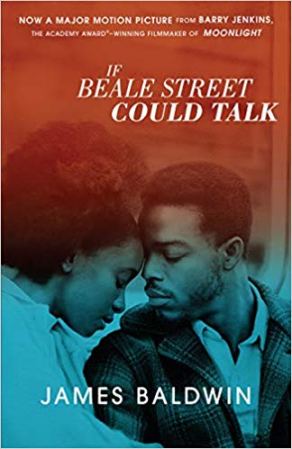
It is a tragic story in many ways – no spoiler intended, but events don’t really resolve in the course of the novel – but has also been described as ultimately uplifting because it shows the power of love, not just between a man and a woman, but also within the community and within the family (notwithstanding the dysfunctional nature of Fonny’s family, although the inference here is that his mother’s religious fervour lies at the root of this).  I have not seen the film so I’m not sure how it handles the open nature of the ending.

The other main theme of the novel is, of course, the black experience, and Baldwin was a key figure in mid-20th century civil rights activism in New York. He counted Nina Simone, Maya Angelou, Marlon Brando, Josephine Baker, Allen Ginsberg and Miles Davis among his many high-profile friends. It is clear that Fonny has simply been set-up to take the blame for the rape – the woman identified her attacker only as black, and in the line-up that was assembled, Fonny was the only black man present. The cops are clearly out to get him, and any other black man. The judicial system, the penal system and the social and financial system are all stacked against Fonny, against them all, a reflection of how Baldwin saw society at the time.

Although I enjoyed the book, I didn’t find it a particularly easy read. The writing felt a little spiky, uncontrolled (the type that a determined editor might address!), but on the other hand it is spontaneous and vernacular, heart-felt and real. I found the timings difficult to follow at times and the supporting characters not as well-developed as I would have liked. It helps, however, when you understand more about Baldwin and his life. Firstly, he was an essayist, poet, playwright and activist as much as he was a novelist, if not more so, and whilst I do not know his other work, I can see that way of thinking in this novel. I think there are also significant influences from Baldwin’s personal life experience which feature strongly – his relationship with his father (actually his step-father), his sexuality, his struggle to express his art in his youth, growing up as he did in the tough neighbourhood of Harlem, and his religious ambivalence.

This is an intriguing and important book, even though it wasn’t always the easiest read. The love story is powerful and moving and it has certainly made me keen to see the film and to read more of Baldwin’s work, particularly his essays and his semi-autobiographical novel Go Tell It on the Mountain.

Recommended.

Have you read the book or seen the film? What did you think?

If you have enjoyed this post, I would love for you to follow my blog. Let’s also connect on social media.

The Reading Challenge for March: “Perfume” by Patrick Suskind

This month’s theme for my Facebook Reading Challenge is a European novel. I confess that I did have the “B-word” in mind when I set the theme, feeling the need to assert that there is more that unites us than divides us, to paraphrase the late Jo Cox. The B-word has at this stage, however, become synonymous with something altogether more sinister – something very worrying is happening to our concepts of democracy, statehood, nationality, political representation and society. No-one really knows where we are or where we’re going.

Photo 11-03-2019, 13 52 18
My thirty year-old copy of Perfume

However, that does not change my belief that we would all do well to push our personal horizons from time to time, literary and otherwise, and engaging with books originally written in other languages is one way of doing that, even if you have to read them in translation. So, the book I have chosen for this month, Perfume by Patrick Suskind, is an absolute classic, and one that I consider to be one of my all-time favourites.

Perfume was first published in 1985 in German, and then in English in 1987. This was also my first year at University, studying English, and I spent those three years reading continuously. Sounds great (it was!) but by the end of it I could hardly even lift a book! Perfume was one of the first books I read after my hiatus, and I was completely blown-away. The novel is set in 18th century Paris and concerns a perfumier Jean-Baptiste Grenouille, his talent for and obsession with all things olfactory, and his descent into a murderous lifestyle – the sub-title of the book is “the story of a murderer”.

I am excited to be reading the book again, although slightly apprehensive – what if I don’t love it as much as I did before? Context matters, so it will be an interesting experience either way.

If you would like to read the book and join the conversation, do pop over to the Facebook page. 

If you have enjoyed this post, I would love for you to follow my blog.


Are you ready for The Oscars?

Well, if you’re like me and based in the UK you probably won’t be staying up until the wee small hours awaiting the big announcements, especially as it’s a school night!

Books are more my thing than films, for sure, but I do love a good movie and going to the cinema remains a treat, even with all the alternative options we have today, such as DVDs, television subscription channels and live streaming. The UK Academy Awards (the BAFTAs) have got bigger over the years, but still don’t match the glitz and the prestige of the Oscars, even though scandals and mishaps have tarnished the image of the US awards ceremony in recent times.

if beale street could talk imgI’m always looking for the films with literary links and they are particularly scarce this year. If Beale Street Could Talk is the only novel-based film, that I could spot, and is based on the Harlem-set love story by James Baldwin, first published in 1974. I’ve just started reading it. The Spike Lee film BlacKkKlansman and the comedy Can You Ever Forgive Me? are both based on memoirs, the former a true story of a young African-American detective who set out to infiltrate and bring down the KKK, and the latter, starring Melissa McCarthy and Richard E Grant, also a memoir, about a celebrity biographer who finds herself out of work and changes tack to become a forger. This one also has a female director (too rare). I haven’t yet seen any of these films, but all of them appeal.

The three films above all have chances of winning big and have been nominated in a number of categories, but I note that in the Best Adapted Screenplay category the Coen brothers have a nomination for The Ballad of Buster Scraggs, a film based partly on short stories, written by the Coen brothers themselves. I don’t know much about this one and I don’t think it’s on general release yet in the UK.

Traditionally, when the Oscars come around, many of the films are fairly new to the UK, so audiences here may not have seen some of them, for example, The Wife, which has not yet reached the north of England. Bohemian Rhapsody and A Star is Born seem to have been around forever. Neither really appeals to me, although friends who have seen them say both are great.

I have seen Roma, Vice and The Favourite and loved all three. Roma was probably the one I found most moving, although Olivia Colman as Queen Anne, manages to draw out the heartbreaking loneliness and isolation of the troubled monarch. Vice is just scary!

I don’t know enough about the film world to offer my top tips, but I will watch the highlights tomorrow with interest and hope that the script for the myriad presenters is less cringe-making than poor Joanna Lumley’s at the BAFTAs!

Which of the big Oscar-nominated movies have you seen and what are your favourites?

If you have enjoyed this post, I would love for you to follow my blog. You can also connect with me on social media.


A few days in Madrid

It has been half term in our household this week. My husband took our daughters off to visit family so I decided that I would take a trip with our eldest, to spend some quality mother and son time together. He will be taking his Spanish A level this summer so I thought it would be good to try and get him to Spain for a bit of speaking practice. I booked the flights three months ago and chose Madrid mainly because we got a fantastic price and the flight times were great. To be honest, though, I was open to going anywhere in Spain; I have been to Barcelona, San Sebastian and the Southern tip around Jerez and Tarifa, and have enjoyed my trips there very much.

Madrid, where both the grand architecture and the narrow streets bring equal pleasures.

Madrid is one of the must-see European cities. There are not too many major ‘sights’ to see, so it is not overwhelming in the same way that, say London or Paris can be (visitors to London: where do you start?), and they are mostly within a compact city centre area. You can take some great trips out of the city, for example to Toledo and Segovia, both within an hour or so, but we decided that remaining central would best suit our purpose. It is a city for walking, eating and art. We took a relaxed approach to sightseeing, soaked up the atmosphere and enjoyed it immensely.

2019-01-29-15.40.16.jpg

Our companion was the Lonely Planet guide to Madrid (I find these are consistently the best travel books). On the first day we followed the suggested walking tour of old Madrid, taking in, amongst other things, the Palacio Real, the cathedral, the Plaza Mayor and, very importantly, the iconic Chocolateria De San Gines, for the ubiquitous churros and hot chocolate (take a bottle of water with you, it is very rich!)

2019-02-19 13.51.31

2019-02-19 12.32.45
Madrid’s oldest tree, planted 1633

On the second day we walked round the wonderful Parque del Buen Retiro, the huge park to the east of the city centre, with its wonderful gardens, footpath, boating lake… and more churros! Madrid’s oldest tree, a Mexican conifer planted in 1633 and with a 52m trunk circumference, stands impressively opposite the Puerte Felipe IV entrance. Near the border of the park is the stunning Museo del Prado, which we went to in the afternoon. Most galleries of this stature need two or three visits to even begin to appreciate the collection, but if you are on a short visit it is worth just taking in the highlights, and the museum provides a handy leaflet with all of these listed. Our guidebook recommended going soon after opening to avoid the queues, but we went around lunchtime and there was no queue at all. The cafe in the museum was over-priced and not particularly good.

On the third day we went to the far west of the city centre to the Parque del Oeste. We planned to go on the Teleferico, a 2.5km cable car that travels over the vast green Casa de Campo, but sadly it was closed for maintenance (an issue with low season). We went to the tiny church of Ermita de San Antonio de la Florida (above) where there are some incredible Goya frescos, and the ancient Templo de Debod, a gift from President Nasser of Egypt, dismantled and transported brick by brick in 1968 (sadly, also closed). We walked back along Gran Via and browsed the shops. I always like to get the measure of a place by checking out its bookshops and Madrid has some fantastic ones, with plenty of foreign language books. There was even a bookshop devoted entirely to mountains (Libreria de Montana, above) in the Huertas district!

2019-02-21 12.37.24-1
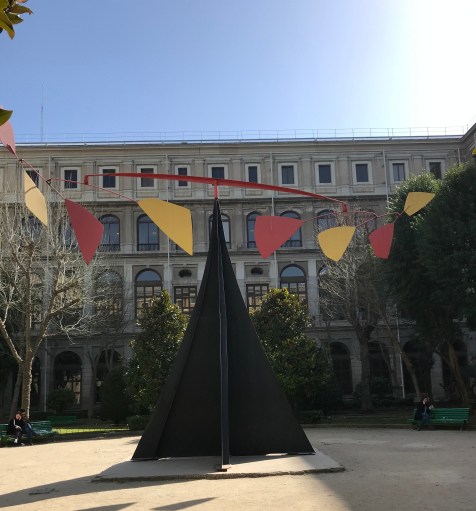
Sculpture in the garden of the Centro de Arte Reine Sofia

On our final day we had plenty of time before our late afternoon flight to take in the modern art gallery of Centro de Arte Reina Sofia, not far from where we were staying. I was particularly keen to see Picasso’s Guernica, a painting I have long admired. It is truly stunning and I am thrilled to have been able to see it in the flesh, as it were. It is surely one of the finest anti-war artworks ever, and, 80 years after it was created, is as relevant as ever. It was worth the €10 entrance fee on its own just to see this, but there are many other stunning works of art to take in, including films explaining the context and history, and the main highlights are all on the second floor, again, useful if you have limited time.

My son and I are both fairly frugal by nature so I was keen to try and do the trip on a budget. We stayed in a little apartment in the Lavapies district, which was quiet and is great value. You can eat fairly cheaply, because there is so much choice and the quality is reliably good (definitely unlike London!). We spent €50-60 a day on lunches and dinners, including a glass of wine with meals. I bought a 10-journey Metro ticket, but we didn’t use it all up as we were able to walk nearly everywhere. That would no doubt have been less comfortable in the summer. February was a great time of year to go and I would definitely recommend it – the weather was mild and sunny and it wasn’t too crowded. We went to the cinema a couple of times, and I was pleasantly surprised to find tickets were only €5-6 each – that’s even cheaper than my little local cinema! My son found this very useful for his Spanish.

Madrid is a fabulous city, the people are warm and friendly, the food is incredible, it’s great value and I recommend it highly. We are completely churro-ed out though!

Have you been to Madrid – what were your highlights?


If you have enjoyed this post, I would love for you to follow my blog. You can also connect with me on social media using the buttons above.

Facebook Reading Challenge 2019 – February’s choice

I was in two minds whether to relaunch my online reading challenge for 2019, not least because I am not one of those bloggers who is able to plan and post in a wholly disciplined way (cf. the fact I am posting about February’s choice halfway through the month!) I am a mother of three teenagers, work part-time, blah, blah, blah, I know you’ve heard it all before – we are all busy. I’ve set myself a reading challenge for the past couple of years now, with the aim of trying to expand my reading from my usual genres and authors, and really enjoyed it. Then in 2018 I took it online and set up a Facebook group for others to take part. To my great surprise and pleasure, it was fairly successful and I enjoyed the conversations we had about the books we’d read, even if they weren’t always universally liked – sometimes you can have more to say or more fun commenting on the ones you don’t like.

Towards the end of the year, though, I faltered, both in my regularity of posting and my ability to get through the books I was selecting for us. This was due largely to family pressures and a period of not being very well. I’d more or less decided that I wouldn’t continue the challenge into 2019, until a few members of the group contacted me to say that they had really enjoyed it. Suitably re-motivated, I relaunched for 2019, albeit a little into January…

Roll of Thunder imgIn January the theme was a humorous novel and we read Beryl Bainbridge’s The Bottle Factory Outing, which I reviewed here last week and which, I think it’s fair to say, did not go down a storm! The theme for February is a YA novel and my selection is Roll of Thunder, Hear My Cry by Mildred D Taylor. This was first published in 1976, probably before the concept of the YA genre as we understand it truly existed, so it is perhaps more accurately categorised as a teen novel. It is widely read as part of the KS3 school curriculum I believe.

Set in the Deep South of America during The Great Depression in the 1930s, its themes are challenging, and the threat of, as well as actual, violence, is never very far away. The central character is Cassie Logan, a nine year-old black girl growing up in a small town and gradually learning about ‘how life is’ for people like her. I am well into the book already and am finding it thoroughly gripping. The evocation of time and place is very powerful and the characterisation very strong. I think this one will be more widely enjoyed.

If you would like to join the conversation, it’s not too late to take part. The book is fairly short so you could easily read it in a few sittings (perfect for teenagers!) I will endeavour to post on time at the end of the month to start the discussion!

Happy reading!

If you have enjoyed this post, I would love for you to follow my blog. Let’s also connect on social media. 

Audiobook review: “Those Who Leave and Those Who Stay” by Elena Ferrante

I’ve just finished listening to this, the third book from Ferrante’s Neapolitan novels. There are four volumes in total and I’ve chosen to listen to all of them on audio, mainly because I love the languid narration by Hilary Huber; she has really brought the characters alive for me and has managed to execute distinctly both the male and the female characters, something which I think is rare in an audiobook.

This is an extraordinary series and if you have not come across them yet (if you’re interested in books you will have been hard-pressed to avoid them since they were published to great acclaim between 2012 and 2015) I would definitely urge you to seek them out. As with the first two volumes, it has taken me some time to get through this book, mainly because I listen to it in 10-15 minute snatches on walks to the shops, etc. My enjoyment is none the worse for that, however; I would say in fact that it has added to my appreciation since this series is truly an epic saga than a set of novels, so broad is the sweep of time that they cover, so the long duration of my listening has given me a strong feeling for that.

Those Who Leave and Those Who Stay imgThis third book picks up precisely where volume two left off, at a small book launch for Elena’s first book, a mildly sexual novel which has caused a stir, and where she is being questioned in a patronising way by an obnoxious critic. A familiar face from Naples walks into the room – Nino Sarratore – and Elena’s confidence is restored. Nino has been a friend since childhood, and there is a complicated triangular relationship between him, Elena and Lila, the main but elusive protagonist of all the books. Elena has been in love with Nino since they were young, but this has not been reciprocated. Like Elena, Nino proved to be a successful student, despite the disadvantages of background and upbringing, and would go on to achieve great things academically, though both know that neither is as brilliant as their mutual friend Lila, with whom Nino was once in a relationship, but who would never reach the academic heights of the other two.

In this volume we follow Elena’s blossoming career as a writer, her marriage to a young Professor, Pietro Airota, and therefore, finally, Elena’s apparent full admission to the bourgeois intellectual circles she has always craved. At the same time, Lila’s life is taking a very different turn – she has left her abusive husband, the vulgar shopkeeper Stefano Carracci, had a child, and leads a modest life. At times, Lila’s life seems extremely harsh, particularly the period when she is working for Bruno Saccavo at the sausage factory, exploited by him and disliked and abused by some of her fellow workers. As Elena’s fortunes are rising, so Lila’s seem to be at their lowest ebb.

As life events ebb, however, so must they also flow, and things reverse. After a period of ill-health, Lila finally manages to claw her way back when she gets a job working for IBM, alongside Enzo Scanno, where she quickly becomes indispensable and starts earning a high salary (the contrast here is that she has achieved this off her own bat, whereas for Elena, despite her academic achievements, her prosperity is largely due to her marriage). At the same time, Elena’s career as a writer stalls, coinciding with the births of her two daughters. She resents her husband for his lack of participation in the household, while she is deeply frustrated by the mediocrity of her daily life, and having to take a back seat while he focuses on his academic career.

The pace of the book becomes quite intense at the end as events spiral towards an inevitable conclusion, which I don’t want to spoil. The writing in this, as in the other two books in the series, is remarkable, and the acute observation of character detail is fascinating and deeply engaging. The dialogue is also some of the most authentic I have ever read. The books have been translated by Ann Goldstein who also deserves praise for her very fine work here.

I am looking forward to the fourth and final book in the series, and highly recommend these novels. Do start with the first one, My Brilliant Friend, and whilst the audio is fantastic, I have also found it useful to have a hard copy to hand to remind myself of the very wide cast of characters.

Have you read Ferrante’s Neapolitan novels – how do you rate them?

If you have enjoyed this post, I would love for you to follow my blog. Let’s also connect on social media.

Book review: “The Bottle Factory Outing” by Beryl Bainbridge

This was my January pick for my 2019 Facebook Reading Challenge, the theme for this month being a humorous novel. I hadn’t read any Bainbridge before and had read that this was considered a comic masterpiece and was in fact shortlisted the Booker Prize in 1974 when it was first published (Bainbridge had no less than four novels shortlisted). This book also won the Guardian Fiction Prize.

So, the book has a pedigree and I had high expectations. I enjoyed it, but I’m afraid to say that I didn’t enjoy it as much as I expected. Perhaps it’s partly timing; I posted a review last week of The Overstory, a book which I found breathtakingly good, and which I completed just before starting this one and I fear that it suffered somewhat in comparison. Perhaps I wasn’t ready for humour after that! I seem to remember having similar feelings about the books I read immediately after completing Hanya Yanagihara’s A Little Life a couple of years ago. There are some books which just need a little more time to sit with you before you launch into something else.

The Bottle Factory Outing imgIn summary, this book is set in the late ‘60s, early 70s and is about Freda and Brenda, two young women who work together in a London factory where Italian wine is bottled. They also live together in a pokey bedsit, and share a double bed at nights. Freda is blonde, buxom and outgoing, sexually frustrated and of a romantic inclination. She has the hots for Vittorio, the nephew of the factory’s Italian owner, and fantasises about being seduced by him, contriving situations to enable this. Brenda is a redhead, but mousey in personality, timid and sexually repressed. She has left her drunken husband Stanley in the Yorkshire farmhouse which they shared with his domineering mother. Freda and Brenda met after Brenda had a tearful outburst in a butcher’s shop. Freda took her in and got her a job at the factory. Freda can be kind but also cruel and the book is as much about the complex nature of relationships between women as anything else.

Almost all the other factory workers are Italian, expect Patrick, an Irishman who seems to be quite protective towards Brenda. The first quarter or so of the book is spent setting the scene before the ‘outing’ takes place. The outing, which was supposed to be by coach to a stately home, was Freda’s idea and was simply one of her plots to try and get Vittorio to declare his passion for her. Inevitably, things start to go wrong when the expected coach does not arrive and some workers have to go home while others pile into cars, and the outing turns into farce. It is a cold and bleak October day, so Freda’s fantasy of a sunlit picnic and strolling through romantic gardens with her hoped-for lover were never going to be realised. The other side-plot is that Brenda is being relentlessly pursued by the (older and married) Rossi, manager of the factory. At work he is always trying to get her into compromising situations.

The outing occupies most of the rest of the book. Inevitably, not all goes to plan and there is a dramatic and unexpected twist, which I won’t spoil by sharing with you. There is definitely humour, but it is very dark. By coincidence, there was a BBC radio broadcast of the story (abridged of course) in mid-January, where the wonderful Maxine Peake and Diane Morgan took the parts of Freda and Brenda, respectively, and Sue Johnstone (masterful) narrates. They drew out both the humour and the tenderness very effectively. In fact I enjoyed the broadcast slightly more than the book! I think this was because the ironic interpretation came across more strongly (the process of abridging perhaps?) and that felt more satisfying for a 21st century reading. Clearly we still have quite a way to go when it comes to gender equality, but you forget how bad things were only 40-50 years ago. In the context of the #MeToo movement, sexual harassment of women in the workplace is more difficult to find funny. Perhaps I am being far too earnest!

I enjoyed the book, but must confess that reading it did at times make me a bit uncomfortable. Which is a shame because I think it is a far more complex novel than a first (post-Overstory) reading allows. I think I need to read it again!

Hmm, what do you think?

If you have enjoyed this post I would love for you to follow my blog. Let’s also connect on social media.

Blogging and stats, and why we do it

traffic-1597342_1280

It is two and a half years since I started blogging. In that time I have published 216 posts. My front page says I have 1,292 followers (thank you!) and I get between six and a dozen likes per post. Whilst there is definitely a gradual increase over time, I know this is not that great, especially after this amount of time and I have often pondered why this is the case. No great revelations to come – maybe what I write just isn’t that interesting! I look enviously at the five and six figure followers other book bloggers have but, to quote Matt Haig quoting Theodore Roosevelt:

“Comparison is the thief of joy.”

I subscribe to a few ‘blogging bloggers’ (!) who write lots of tips about how I can increase my following, but, to be honest, I don’t read a lot of the posts exhorting me to do x or y, or find out how z increased their following to so many hundred thousand in a week. As a busy mother of three with a part-time job, I find I don’t really have the time to read all these emails, let alone follow the advice. And frankly when I want to read, I’d rather read a book!

At the end of 2018, I spent some time reflecting on what my life’s priorities are and what I want to achieve in the year ahead. I turned fifty last year so that also gave me pause for thought. There’s no point doing things in life that don’t serve you. I like blogging, I like writing about the books I read, it helps me to enjoy them more, reflecting on what I’ve learned, so that’s why I do what I do. I don’t do it for followers, or for money (sorry, blogging bloggers, I don’t want to do ads), and whilst I accept a bit of social media is important, I don’t want to do it ALL the time. I blog because I like to communicate my thoughts about books, and it’s a great thrill when someone comments and you can engage in a conversation. (It’s also made me realise that I should comment more on other people’s blogs that I enjoy.)

So, forget the stats, ignore the number of likes, self-worth should not be dependent on that. In 2019 I’m going to do what I enjoy and enjoy what I do!

Do your blogging stats ever get you down? What do you do to try and increase your reach?

I would love it if you could follow me!


Book review: “The Children Act” by Ian McEwan

I haven’t read that many books by Ian McEwan – about four I think, not as many as I would like. Each time I read one, I am so overwhelmed by the quality of the work, the writing, the ideas behind each novel, that I wonder why on earth I haven’t read every single thing he’s written, especially as most of them aren’t terribly long. I’ve just finished The Children Act which was my book club’s choice for January. I read it in just a couple of days; the story was not only utterly compelling, but the prose was a joy. McEwan’s easy brilliance just draws you in and I found it hard to put down – one of those books you just have to pick up while you wait for the kettle to boil, just to enjoy the next couple of paragraphs. I felt similarly about On Chesil Beach which I read in 2017, but I’d go so far as to say this book is even better.

The central character is Fiona Maye, a High Court judge in the Family law division. She is considered brilliant at her job. She deals with both high-profile celebrity divorces, as well as complex and difficult cases. Not just difficult, but the kinds of cases that most of us would find virtually impossible to adjudicate, such as one particularly challenging case we are told about of two conjoined twin babies. Left together, both would eventually die, but separation would mean doctors could save the stronger of the two, but with the certain and immediate death of the weaker one. In essence, killing one baby to save the other. Fiona reaches conclusions on these kinds of impossible moral dilemmas.

Fiona is 60 and married to Jack, an academic. They have no children, but plenty of nieces, nephews and god-children. They seem settled in their comfortable, affluent, London life until, on the eve of a difficult case, Jack announces that he is finding their marriage sexually unsatisfying and would like to go and have a final fling while he still has it in him. Fiona is horrified and they argue bitterly. The evening ends with Jack leaving the flat, to go off to the young woman he plans to have an affair with, Fiona presumes.

The case over which Fiona is about to preside is an urgent one and she must immediately switch off from her marital crisis in order to focus on her work, where she feels in control.

“No denying the relief at being delivered onto the neutral ground, the treeless heath, of other people’s problems.”

The case on which she is being asked to rule concerns Adam Henry, a teenager, three months short of his 18th birthday, who has leukaemia. His proposed treatment involves a combination of drugs which will also require him to receive a blood transfusion, but, as a Jehovah’s Witness, his parents object to this course of action, and so, it is reported, does Adam. The hospital wants to proceed with the remaining treatment and the transfusion, and to do so immediately in order to save his life, and wishes the Court to rule that, as a child, he can be forced to have it (if he were an adult he would have the right to refuse treatment). Fiona hears the evidence from all sides and decides that before reaching her decision she will visit Adam. The visit affects Fiona deeply, more than she will realise.

It is tense reading as we wait to find out what Fiona will decide. No spoiler here, I won’t tell you her conclusion. Suffice to say that her decision has repercussions, which are primarily about her going through a kind of breakdown, of all that she has believed and taken for granted up to now, and this affects also how she responds then to Jack and the situation of their marriage.

This is both a touching and deeply affecting novel about one woman’s internal struggles and about human relationships in general and the nature of marital love in particular. And at the end we are invited, in a way, to judge Fiona, the Judge. McEwan has some brilliant turns of phrase which left me breathless with admiration and his economical style of writing makes him highly accessible and exciting to read.

I loved this book and recommend it highly.

Which McEwan shall I read next? What is your personal favourite? 

If you have enjoyed this post, I would love for you to follow my blog. Let’s also connect on social media.