Time for my second Man Booker shortlist review and of the three I have read so far, my favourite. I wasn’t expecting to enjoy it as much as I did; the subject matter – a D-Day veteran suffering from PTSD – did not appeal particularly and when I saw the format – extended verse – I found my heart sinking slightly. That’s totally unfair, and I can in no way begin to justify that reaction other than to say I just love a good solid novel! I am delighted to say I was completely wrong, and I think it’s great when our prejudices and preferences are tested and we are pleasantly surprised.
 The central character is Walker, a man from rural Nova Scotia, who fought with the Allied forces in the D-Day landings. He has seen and experienced terrible events, death and injury that most of us can barely even imagine, and he survived. After the end of the war, he goes back to the United States and finds himself living among the homeless in New York City. The book is divided into four sections: 1946, 1948, 1951 and 1953 each set in a different US city (though Los Angeles is the setting for both 1948 and 1953). As he reflects on his experiences, it becomes clear that it was impossible for him to return home to Canada. He reminisces about the quiet, gentle life he led there, where the rhythms of the seasons, the dependence on the harvests of the seas, and community events (such as village hall dances) dominate everyone’s existence. It’s as if the contrast between that life and the brutality he witnessed in the war means he fears contaminating the innocence of those he has left behind. He can never go back, never unsee what he has seen, and those he once loved will never be able to understand how he has been changed.
In New York City, Walker lives among the vulnerable and the dispossessed. He is already suffering the effects of his PTSD:
“A dropped crate or a child’s shout, or car
Backfiring, and he’s in France again’
That taste in his mouth. Coins. Cordite. Blood.”
In 1948 Walker moves to Los Angeles and begins working on a city newspaper, initially writing film reviews, but then, as his profile grows and he earns respect among fellow journalists for his writing, he is given weightier projects. He persuades his Editor to let him do an extended investigation into homelessness. This takes him to San Francisco in 1951, and then back to LA in 1953. Walker is an observer, he seems to move on the periphery. He earns the trust of the cast of characters he befriends on the streets and his own personal trauma enables him to empathise with them:
“People; just like him.
Having given up the country for the city,
Boredom for fear, the faces
Gather here in these streets
Like spectators in a dream.
They wanted to be anonymous
Not swallowed whole, not to disappear.”
The final part of the book is the most intensely drawn. Walker recalls the devastation of older parts of the city, the traditional buildings, to make way for modern concrete highways and car parks, fuelled by corruption in the city authorities and mafia money. In the process many of the itinerant population were made homeless from whatever meagre shelter they had created for themselves and effectively thrown onto the scrap heap. The account of the destruction of the soul of the city is juxtaposed with vivid and detailed descriptions of the war:
“The side of a building fell like a tree.
Then the rest of it just collapsed
In on itself, immediately lost
In a dense cloud of brick dust;
The delay of the noise and shock waves.
There was an army there, pulling down everything north of 1st.
…
The sound of mortars like gravel on a metal slide; a running tear. Right next to me, young Benjamin took some shrapnel in the throat: his windpipe torn open, so he’s gargling blood and staring at me, fumbling at his neck like he feels his napkin is slipping.”
What is fascinating and moving about the work is how Walker’s wartime experiences have made him more human, more empathic, whereas those who live oblivious are consumed by inhumanity, lack of feeling for others and, in the case of the authorities, cruelty. America is failing those in need in the pursuit of economic growth, greed and modernism.
I thought I would find the verse structure annoying, but it is beautiful, as is the economy of Robertson’s language. It perfectly suits the slightly ethereal, enigmatic central character and his own relatively silent presence in the communities in which he moves and verse provides a way of creating the vivid imagery of his wartime recollections.
I recommend this book highly. Don’t be put off if you are not used to reading verse, you will get used to it quickly. An amazing piece of work.
What is your favourite book on the Man Booker 2018 shortlist so far?
If you have enjoyed this post, I would love for you to follow my blog. Let’s also connect on social media.
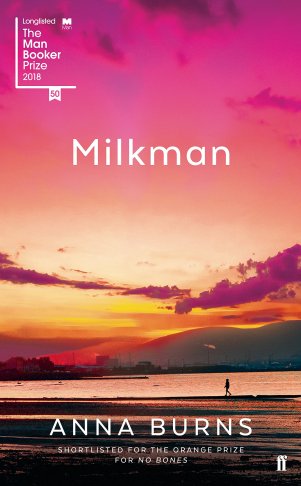 Milkman is set in Belfast during the Troubles in Northern Ireland and the central character and narrator is a young Catholic woman who finds herself drawn unwillingly into a relationship with a local paramilitary leader. It is not clear when the book is set, but I am guessing around the late 1970s, early ‘80s. Northern Ireland is known to be socially conservative, but the general sense of the place of women in society suggests to me that it dates back quite some time. Our central character (not named, I’ll come onto this) is from a large family. Her father is dead and she has several siblings, both older and younger. She is in a “maybe-relationship” with a local young man, who she has been seeing for about a year, though they have not made a commitment to one another. She is keen on running as a hobby and shares this with “third brother-in-law”. Whilst out running one day in a local park she finds that she is observed by a man in a white van. Over subsequent weeks he infiltrates her life by stealth, indicating that he expects her to have a relationship with him. He is known only as “Milkman”. It becomes clear to her that he is quite a powerful local figure in the paramilitary world, so not only does she have little choice about whether to become involved with him or not, it is made quite clear to her that as long as she goes along with him no harm will come to her “Maybe-boyfriend”.


 This book, like Welford’s others, is set in North Tyneside (where I used to live, so it resonates with me for that reason too), on the coast east of Newcastle. Alfie Monk is over 1,000 years old, having been born at the time of the Danish invasions of Britain. When he was young, his father was custodian of some ‘life pearls’ within which were stored an elixir of eternal life. To access the elixir the life pearls had to be smashed and the liquid consumed. Alfie’s father was involved in a fight with someone who tried to steal the life pearls, and he was killed. Alfie (unfortunately?) smashed two of them accidentally; he and his mother (and their cat!) drank the liquid, meaning they will never age and therefore never die of natural causes. The curse can only be lifted by drinking another dose of liquid, but there is only one life pearl left. This is hidden on a remote island off the Northumberland coast.


 This shortlist was announced in May and the list was then put up for a public vote. My personal favourite of these was Wolf Hall. In 1983, the celebrate the 25th anniversary of the prize a “Booker of Bookers” contest was set up and three judges chose Salman Rushdie’s Midnight’s Children, which I probably agree with. It was good to see the vote open to the public this time rather than a small group of the literati, and the winner was
  In some ways, there is not a great deal to say about Death on the Nile that you couldn’t say about any other Christie novel, I suspect: there is a situation, in this case, a Nile cruise, being undertaken by 10-15 characters, all for different reasons. Conflicts and tensions are set up amongst the different characters, mysterious aspects of their personality or behaviour are noted, one of their number dies and then there is a process of detection to work out whodunnit. I did largely guess the correct outcome in the case of this novel, although I didn’t with Orient Express.
 I managed to read


 We are staying in Cancale, a smallish coastal town in Northern Brittany, arriving here on the overnight ferry from Cork to Roscoff, which was very pleasant indeed – good, reasonably-priced food, decent cabins and plenty to do.
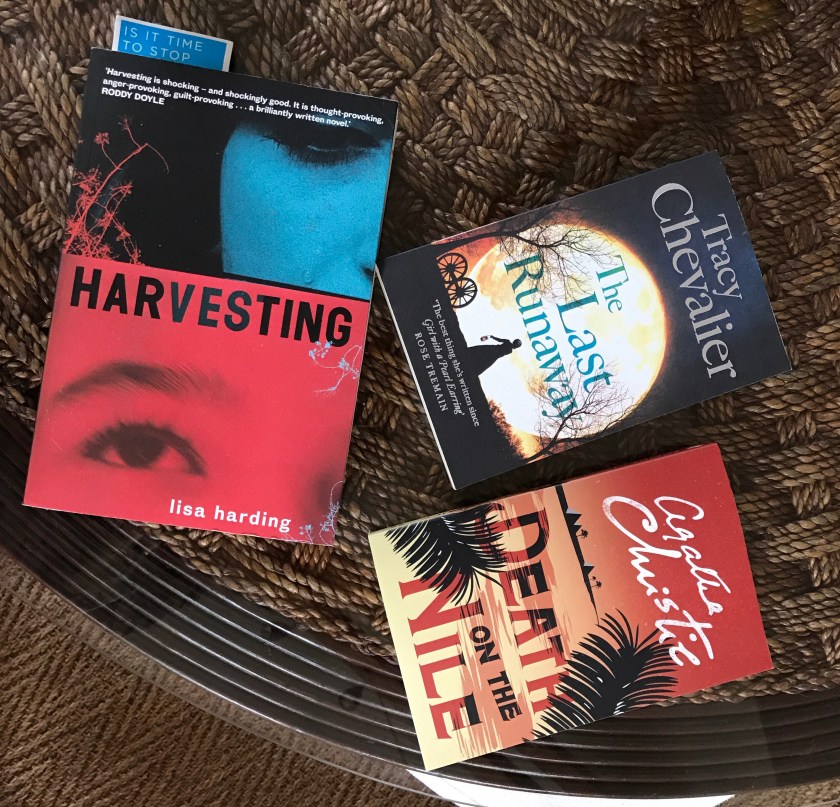
 I’ve been unusually restrained with my holiday library this year, just the three books: Harvesting by Lisa Harding, a harrowing account of child prostitution, child trafficking, abuse and neglect, Death on the Nile, by Agatha Christie, the August choice for my Facebook Reading Challenge, and The Last Runaway by Tracy Chevalier, one of my book club’s summer reading titles.
